
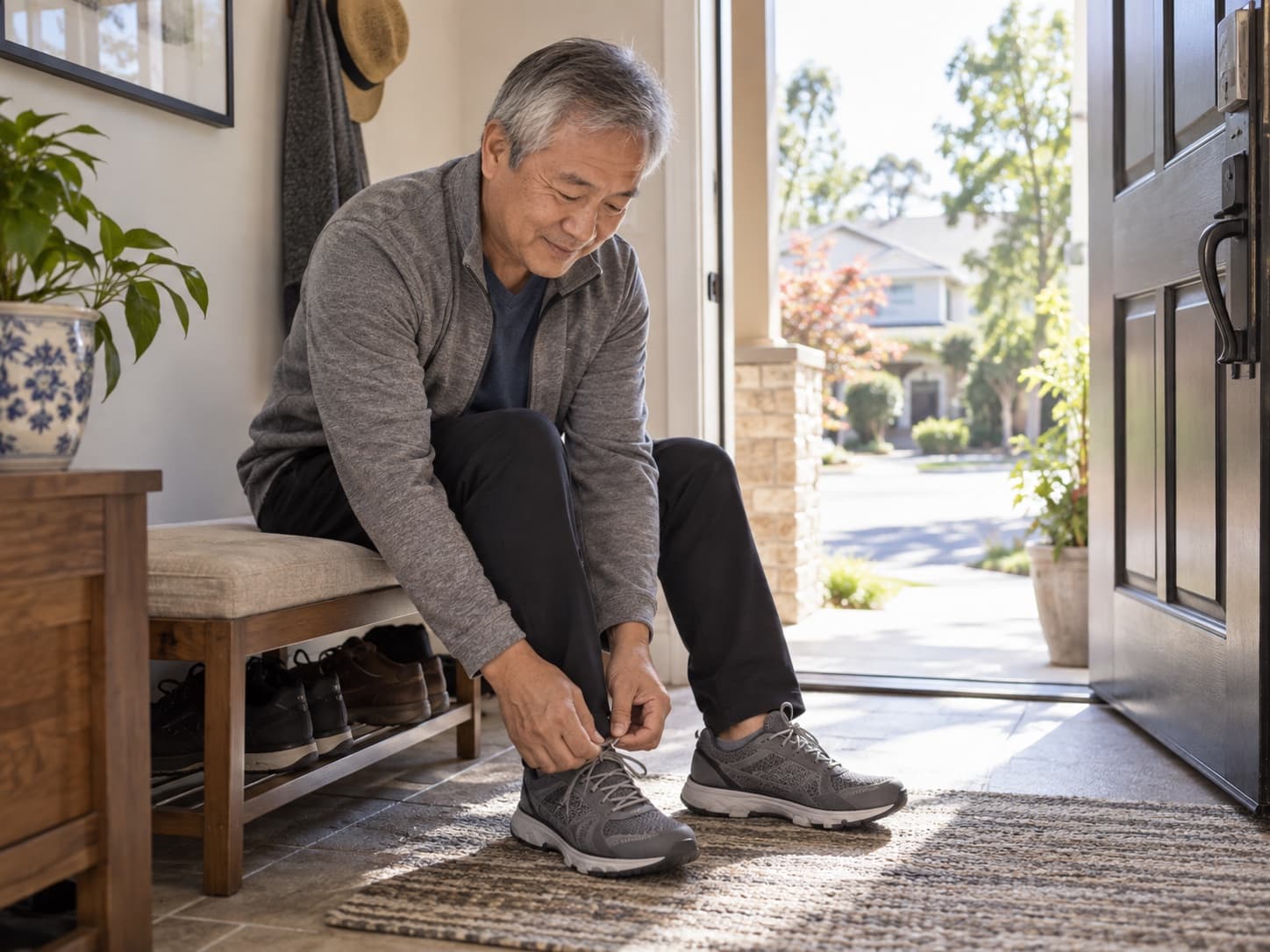
Ask a room full of people over 50 what they do for exercise, and the most popular answer won’t be close: “I walk.”
Good. Walking may be the single best habit a person can keep, and the U.S. Physical Activity Guidelines specifically urge older adults to do it.
But walking is a specialist. Your heart and lungs love it. Your bones barely register it. Your thigh muscles soon find it as challenging as a crossword you’ve already solved. And it does little to prepare you for the morning your heel lands on a patch of black ice.
Exercise isn’t one thing. It works more like a crew, and healthy aging needs four distinct jobs covered. Most people over 50 have one or two handled and don’t realize the other positions are vacant.
Job one: keep the engine running
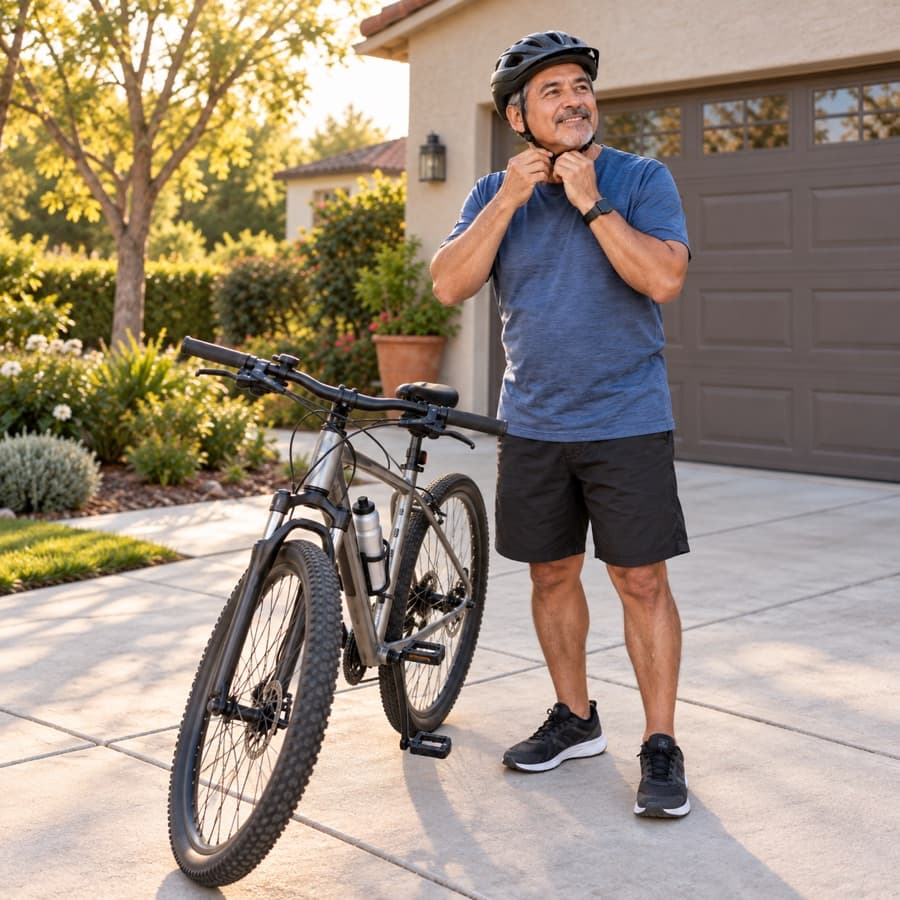
This is walking’s home turf, shared with cycling, swimming, dancing and anything else that keeps you pleasantly out of breath. The guidelines ask for 150 to 300 minutes a week of moderate aerobic activity, or about half that if the effort is vigorous.
No heart-rate monitor required. Picture a scale that has sitting on the couch is 0 and an all-out sprint is 10. Moderate effort lands around 5 or 6: you can still talk, but you wouldn’t want to sing. That personal yardstick beats any chart, because “brisk” means something very different at 52 than at 78.
If 150 minutes sounds like a mountain, here’s a finding worth taping to the fridge. A meta-analysis of nine studies covering more than 122,000 adults over 60 found that people who did less than the recommended amount, but more than nothing, had a 22% lower risk of dying during follow-up than people who were inactive. The studies were observational, so they show a link rather than proof, but the pattern is consistent: the biggest leap comes from getting off zero.
Step counts tell a similar story. Pooling 15 studies of nearly 48,000 adults, researchers found the benefit for people 60 and older flattened out around 6,000 to 8,000 steps a day. Not the famous 10,000.
The engine work reaches your brain, too. In a well-known trial of 120 older adults, a year of walking three days a week enlarged the hippocampus, a memory-related region that normally shrinks with age, by about 2%. The researchers likened that to turning back one to two years of typical shrinkage. One study doesn’t make walking a dementia shield, but your brain is an organ with a blood supply, and it notices when you move.
Job two: maintain the frame
Here’s where walking runs out of road. Muscle and bone respond to load, and once your legs adapt to your daily route, the route stops asking them anything new.
Strength training fills the gap, and the evidence for it in older adults is unusually solid. A Cochrane review of 121 trials involving about 6,700 older adults found that progressive resistance training improved strength and everyday physical function, including walking speed and getting up from a chair, with serious problems rare. Those abilities decide whether you carry your own suitcase up the stairs.
A large review linked muscle-strengthening activity with a 10% to 17% lower risk of dying from any cause, heart disease and cancer, and the benefit appeared to peak at roughly 30 to 60 minutes a week. That’s two half-hour sessions, though again, the data are observational.
Bone is the other half of the frame. In Australia’s LIFTMOR trial, postmenopausal women averaging about 65, all with low bone mass, did supervised heavy lifting and impact work twice a week for eight months. Their lumbar spine density rose 2.9%, while a comparison group doing a gentle home program lost 1.2%. The key word is supervised: if you have osteoporosis, heart disease or high blood pressure, work with a qualified trainer and your doctor before going heavy.
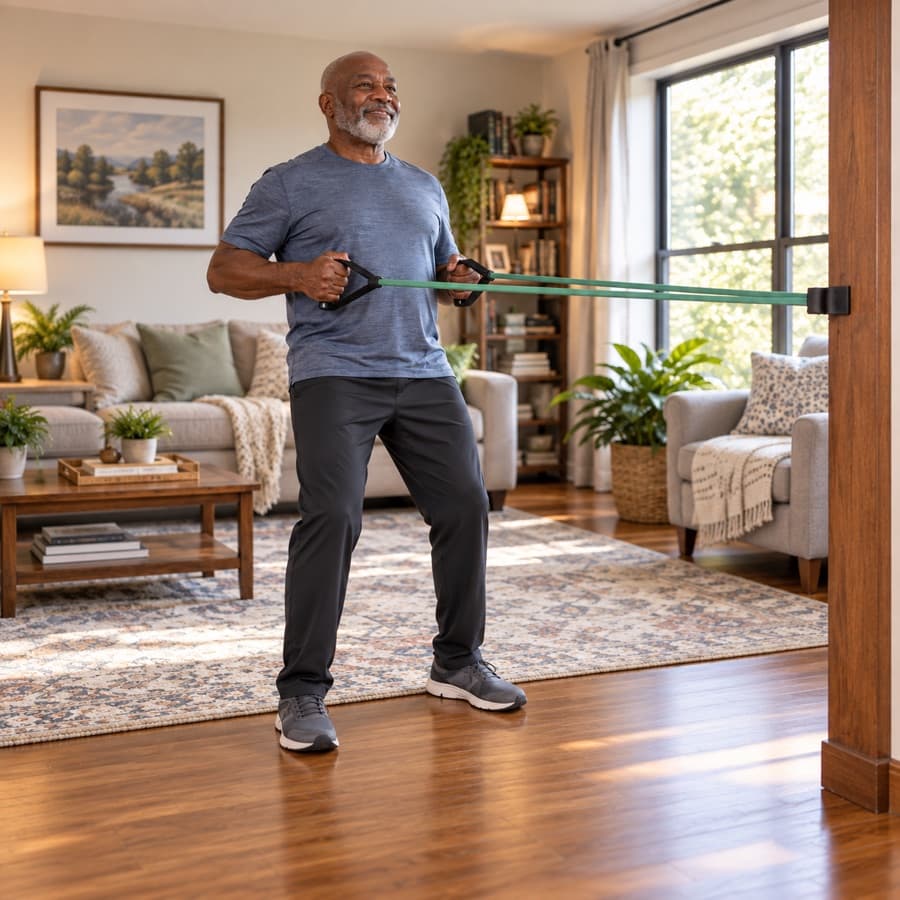
A simple way in. Two days a week, with a rest day between. Pick six to eight moves that cover legs, hips, back, chest, shoulders and arms: chair stands, wall push-ups, step-ups, band rows, carrying a loaded shopping bag. Do one to three sets of eight to twelve reps; the last few should feel hard but not painful. Breathe out as you lift and never hold your breath. When it feels easy two sessions running, add a little weight.
The garden counts, too: the guidelines list digging, lifting and carrying as muscle-strengthening activity. Hauling mulch is a workout in work boots.
Job three: stay upright
Balance is the job almost nobody trains on purpose, which is a shame, because it’s one of the best-proven payoffs in the field.
A Cochrane review of 108 trials found that exercise reduced the rate of falls in older adults by 23%, and programs mixing several types of exercise, usually balance plus strength, did better still, cutting falls by about a third. Tai chi has produced some striking results. In one trial of 670 adults aged 70 and older at high risk of falling, a tai ji quan program led to 58% fewer falls than a stretching program. Pooled tai chi evidence is less certain, so call it promising.
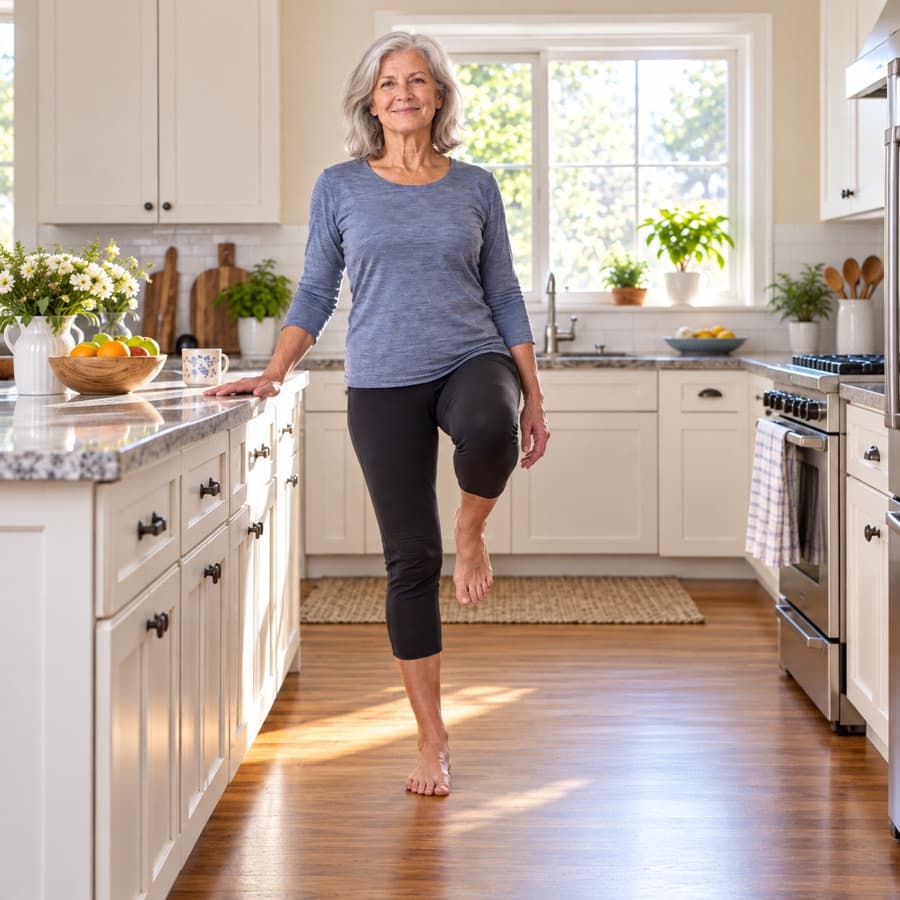
The guidelines specifically ask adults 65 and older to build balance training into their week, and it’s wonderfully portable. Stand on one foot while you brush your teeth, near the counter. Walk heel to toe down the hallway. Rise from a chair without using your hands. Walk a trail now and then, where every step lands a little differently. When something feels easy, nudge it harder: close your eyes for a few seconds, or stand on a cushion.
Job four: keep you coming back
The fourth job is the one textbooks skip: making movement something you want to do. Every benefit above depends on years of showing up.
Norway’s Generation 100 study offers a fascinating clue. Researchers assigned 1,567 adults aged 70 to 77 either to supervised training sessions, including high-intensity intervals, or to simply following the national activity guidelines, then tracked them for five years. The supervised training didn’t reduce deaths beyond what the guideline group achieved. Many people in that comparison group stayed active on their own, and plain consistency held its own against the fancy protocol.
So choose activities with a pull of their own: pickleball, a dance class, water aerobics, a standing Saturday hike. Social commitments work like a gym membership with a conscience: someone notices when you don’t turn up.
Two are better than one; because they have a good reward for their labour.
Here, the reward is a partner who texts “Court 3 at nine?” on mornings you’d otherwise stay in bed.
The proof is in the mix
If one study shows why covering all four jobs matters, it’s LIFE. Researchers recruited 1,635 adults aged 70 to 89 who were inactive and already had some physical limitations. Half did walking plus strength, flexibility and balance work; half attended health education classes.
Over about two and a half years, 30.1% of the exercise group developed a major mobility disability, meaning they lost the ability to walk about a quarter mile, compared with 35.5% of the education group. In a group that size, the gap works out to roughly 44 more people still walking to the mailbox, the bus stop and the grandkids’ recitals.
Building a week without rebuilding your life
You don’t need a perfect plan, just each job covered in most weeks:
- Most days: 20 to 45 minutes of something aerobic you enjoy.
- Two days: 20 to 40 minutes of strength work, with a rest day between.
- Most days: 5 to 10 minutes of balance practice, tucked into routines you already have.
- Once a week: something social or adventurous.
Starting from zero? Shrink everything. A 10-minute walk plus a few chair stands during the evening news is a legitimate program. Add a minute or two each week, changing one thing at a time.
Already fit? Your gaps are probably strength and balance; endurance types are notorious for skipping both. Add progressive lifting and, if you enjoy them, a weekly interval session.
Living with pain or a health condition? Water exercise, a stationary bike and seated strength moves all cover real jobs. Ask your doctor or physical therapist what to avoid and which symptoms mean stop.
Week fell apart? Use the weekend. A large British study found that people who packed their activity into one or two days a week had about a 30% lower risk of dying than inactive people.
Light or moderate activity like brisk walking rarely needs medical clearance. Check with a doctor before vigorous exercise if you have heart, lung or kidney disease, diabetes or uncontrolled blood pressure. Stop and call for help right away if you feel chest pain or pressure, severe breathlessness, dizziness, or sudden weakness on one side.
Try this: the four-job audit
This week, list the seven days down the side of a page and draw four columns across the top: Engine, Frame, Balance, Fun. Tick the columns each activity covers. A pickleball match might tick three at once.
On Sunday, look for the empty column. Next week, add a single ten-minute session aimed only at that job. One empty column, filled.
As long as you live, keep learning how to live.
Seneca wasn’t writing about squats, but he could have been. Your body keeps learning at 60, 70 and well beyond, as long as you keep giving it new lessons. Find your empty column and start there.
Sources
- U.S. Department of Health and Human Services. Physical Activity Guidelines for Americans, 2nd ed., 2018.
- Bull FC et al. World Health Organization 2020 guidelines on physical activity and sedentary behavior. Br J Sports Med 2020.
- Hupin D et al. Even a low dose of moderate-to-vigorous physical activity reduces mortality by 22% in adults aged ≥60 years. Br J Sports Med 2015.
- Paluch AE et al. Daily steps and all-cause mortality: a meta-analysis of 15 international cohorts. Lancet Public Health 2022.
- Erickson KI et al. Exercise training increases size of hippocampus and improves memory. PNAS 2011.
- Liu CJ, Latham NK. Progressive resistance strength training for improving physical function in older adults. Cochrane Database Syst Rev 2009.
- Momma H et al. Muscle-strengthening activities are associated with lower risk and mortality in major non-communicable diseases. Br J Sports Med 2022.
- Watson SL et al. High-intensity resistance and impact training improves bone mineral density and physical function in postmenopausal women with low bone mass (LIFTMOR). J Bone Miner Res 2018.
- Sherrington C et al. Exercise for preventing falls in older people living in the community. Cochrane Database Syst Rev 2019.
- Li F et al. Effectiveness of a therapeutic tai ji quan intervention vs a multimodal exercise intervention to prevent falls among older adults at high risk of falling. JAMA Intern Med 2018.
- Lomas-Vega R et al. Tai chi for risk of falls: a meta-analysis. J Am Geriatr Soc 2017.
- Stensvold D et al. Effect of exercise training for five years on all cause mortality in older adults: the Generation 100 study. BMJ 2020.
- Pahor M et al. Effect of structured physical activity on prevention of major mobility disability in older adults: the LIFE study. JAMA 2014.
- O’Donovan G et al. Association of “weekend warrior” and other leisure time physical activity patterns with risks for all-cause, cardiovascular disease, and cancer mortality. JAMA Intern Med 2017.
Quotations: Ecclesiastes 4:9, King James Version; Seneca, Moral Letters to Lucilius, Letter 76, tr. R. M. Gummere.