

Imagine being 75 and carrying your own luggage through an airport, hiking a beautiful trail, dancing at a wedding, or chasing your grandchildren around the backyard.
Now imagine being able to do all of that without giving it a second thought.
That’s a much more interesting fitness goal than fitting into the jeans you wore at 35.
And here’s something worth knowing: Your muscles don’t have an expiration date. Neither does your ability to improve your endurance, coordination, or balance. Even people who begin exercising relatively late in life can make meaningful gains.
The trick isn’t finding one magical exercise. It’s building the combination of strength, cardiovascular fitness, mobility, and balance that keeps your body useful for the things you actually enjoy.
Your body needs more than one kind of fitness
Think of your physical fitness as a well-equipped toolbox.
Strength training gives you the muscle to lift, push, pull, and carry. Cardiovascular exercise gives you the stamina to keep going. Balance helps you stay steady when the ground is uneven. Mobility lets your joints move comfortably through the positions life demands.
Neglect one, and you may discover the limitation somewhere inconvenient.
You could have the strength to lift a heavy suitcase but lack the endurance to walk across a sprawling airport. Or you might walk five miles comfortably but struggle to get up from the floor.
The World Health Organization recommends that older adults combine aerobic activity with muscle-strengthening exercise and regular activities that challenge balance and functional movement.
For most adults, the familiar aerobic target is 150–300 minutes of moderate activity each week, alongside strength training at least twice weekly. Older adults are also encouraged to incorporate multicomponent activity emphasizing balance and strength on three or more days a week.
That sounds like a lot until you realize that walking, gardening, dancing, climbing stairs, and playing with your grandchildren can all contribute to an active life.
And your strength training doesn’t have to be complicated.
Five strength exercises that pay dividends in everyday life
The most useful exercises often resemble ordinary movements. You don’t need elaborate machines or a collection of expensive equipment.
Start with these five.
1. The suitcase carry: Make carrying things feel easier
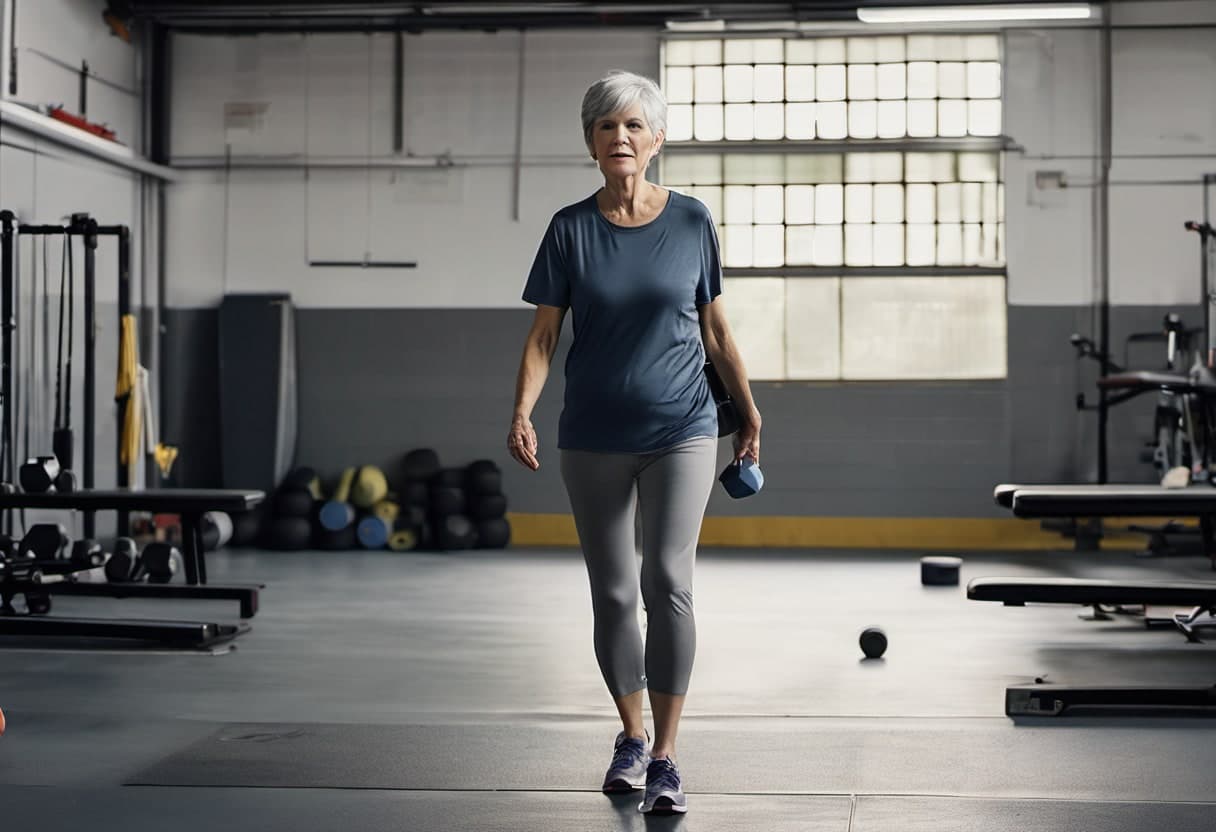
Ever carried a heavy grocery bag in one hand while trying not to lean sideways?
That’s essentially a suitcase carry. Done deliberately, it becomes a terrific exercise for your grip, trunk muscles, and ability to maintain an upright posture while moving.
Hold a dumbbell or moderately weighted bag at your side. Stand tall, keep your shoulders level, and walk slowly for 20–30 seconds. Switch hands and repeat.
Start with two rounds per side. Choose a weight that challenges you without pulling your torso sideways.
If walking with the weight feels unsteady, practice holding it while standing beside a sturdy counter.
For an additional challenge, carry a weight in each hand. That’s called a farmer’s carry, and it develops your ability to transport heavier loads.
The payoff? Groceries, luggage, garden supplies, and all those other objects that stubbornly refuse to carry themselves.
2. Step-ups: Prepare your legs for the real world
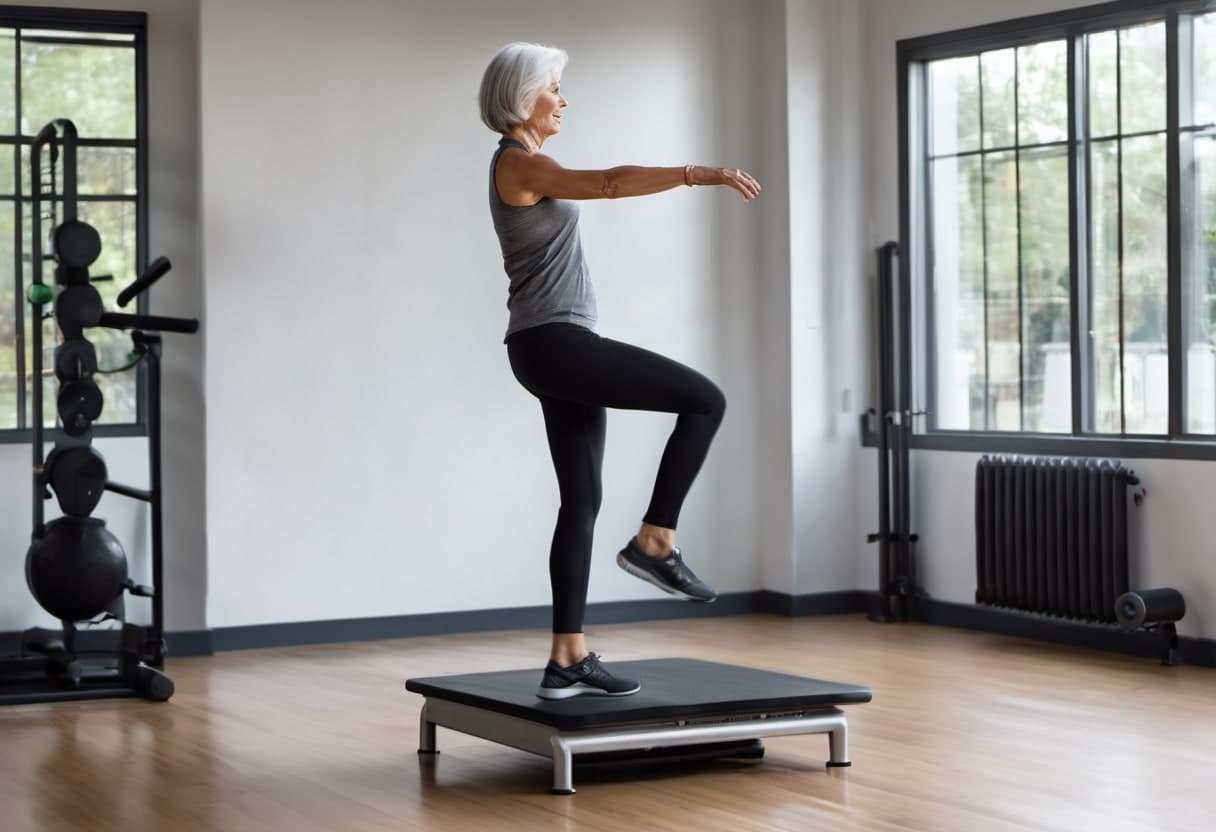
Stairs are everywhere. So are curbs, porches, buses, and uneven paths.
Step-ups train the leg strength and control you need to navigate them.
Stand in front of a low, stable step. Place one foot on it, press through that foot, and rise until you’re standing on top. Step down slowly, keeping your knee aligned with your foot.
Begin with 6–10 repetitions per leg, for one or two sets.
Use a railing or sturdy support when needed. A low step is perfectly effective for beginners. You can increase its height or add light weights as you improve.
The controlled descent matters as much as the climb. Your thigh and hip muscles must work to lower your body smoothly, a skill you’ll appreciate on long staircases and downhill walks.
3. The deadlift: Learn to lift without fighting your back
The word deadlift sounds intimidating. The movement itself is something you already do.
Whenever you pick up a bag from the floor, you’re performing a version of it.
The difference is that a properly practiced deadlift teaches you to use your hips and legs effectively while keeping the load close to your body.
Begin with a kettlebell or dumbbell positioned on a sturdy raised surface. Stand with your feet approximately hip-width apart. Push your hips backward, soften your knees, and reach for the weight while maintaining a comfortable, stable back position.
Stand up by extending your hips and knees together. Then lower the weight slowly.
Try 8–10 repetitions for two sets.
You don’t need to touch the floor. Raising the weight reduces the range of motion and can make the exercise much more accessible.
Over time, gradually increase the weight or lower the starting position as your strength and mobility allow.
4. Chair squats: Build the strength you use dozens of times a day
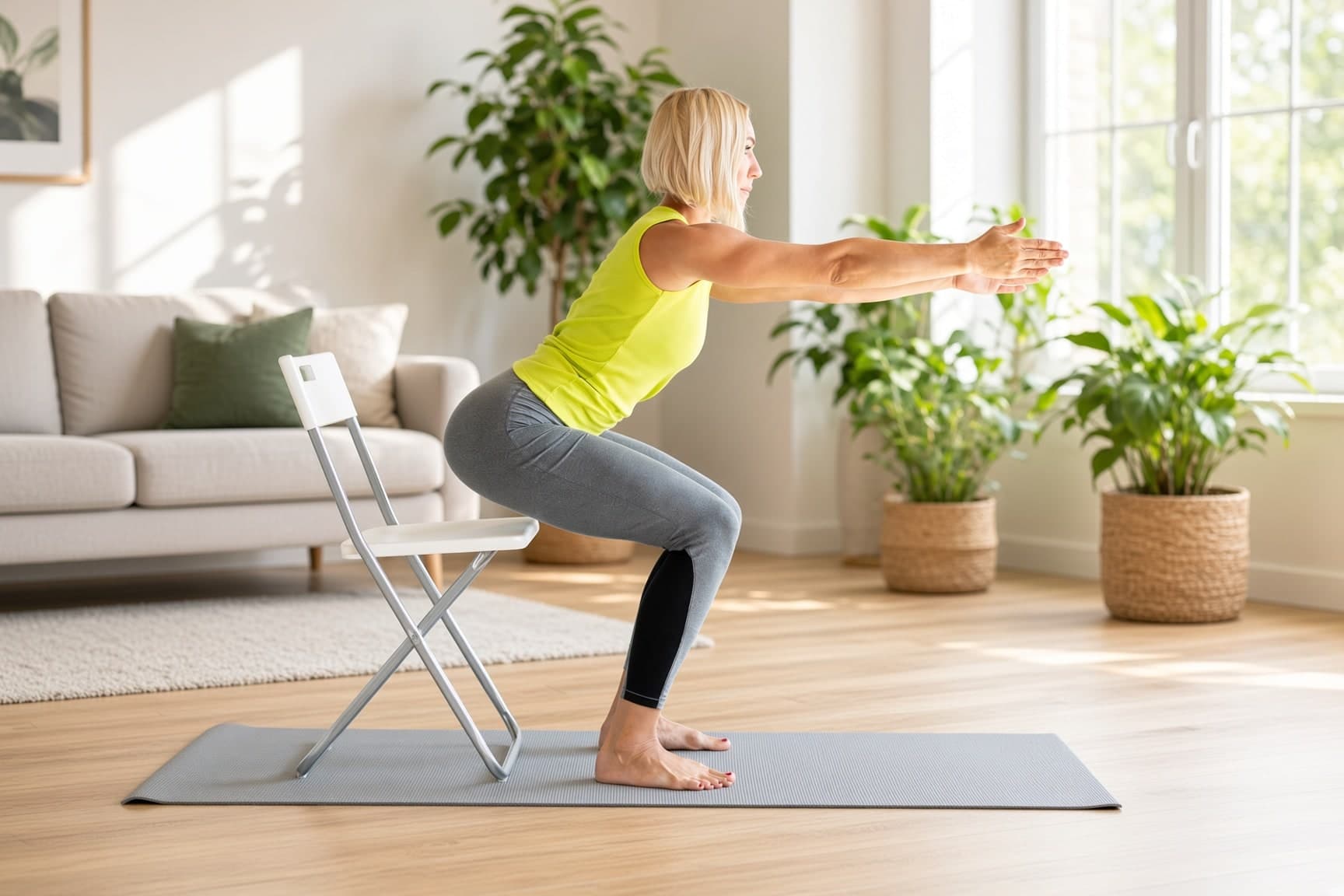
Here’s a useful experiment: Sit in a sturdy chair and stand up without pushing off the armrests.
That simple movement reveals a great deal about the strength and coordination of your hips and legs.
To train it, sit toward the front of a stable chair with your feet flat on the floor. Lean your torso slightly forward, press through your feet, and stand. Lower yourself back down with control.
Start with 8–12 repetitions.
If necessary, use your hands for assistance. If it’s easy, lower yourself until you barely touch the chair before standing again, or hold a light weight against your chest.
Chair squats aren’t merely a beginner exercise. With sufficient resistance, they can challenge strong, experienced exercisers too.
5. Push-ups: Upper-body strength without a gym
Being able to push matters more than you might think.
Getting up from the floor, moving furniture, opening a heavy door, and pushing yourself out of a deep chair all require upper-body strength.
A push-up trains your chest, shoulders, arms, and trunk together.
But there’s no requirement to begin on the floor.
Place your hands on a sturdy countertop, step backward, and keep your body in a straight line. Bend your elbows to bring your chest toward the counter, then push away.
Aim for 6–12 controlled repetitions.
As you grow stronger, move to a lower, stable surface. Eventually, you might progress to floor push-ups.
The right variation is the one that challenges you while allowing good control.
Your heart needs exercise too—and walking is only the beginning
Strength gives you the ability to do something. Cardiovascular fitness helps determine how long you can keep doing it.
Brisk walking remains one of the most accessible ways to build aerobic endurance. It requires little equipment, can be adjusted to nearly any starting level, and offers opportunities to explore your neighborhood or spend time with friends.
But cycling, swimming, dancing, rowing, and hiking can also get your heart working.
How hard should you go?
For moderate-intensity exercise, use the talk test: You should be breathing noticeably harder but still able to carry on a conversation. If you can sing comfortably, you may be moving too easily to reach moderate intensity. If you can barely speak, you’ve probably moved into vigorous territory.
Start with 10–15 minutes if you’re relatively inactive. Gradually extend your sessions as they become comfortable.
Already fit? Try incorporating hills, longer rides, or short periods of faster walking.
Consistency matters far more than choosing the trendiest activity.
And remember, you can divide your movement throughout the day. A brisk walk after breakfast and another after dinner both count.
Balance: The fitness skill people forget to practice

Balance is a remarkable collaboration between your eyes, inner ears, nervous system, and muscles.
When you step onto uneven ground, your body makes countless tiny corrections without requiring a committee meeting in your brain.
Like strength, balance responds to practice.
Begin by standing beside a countertop and lifting one foot slightly off the floor. Hold for 10–20 seconds, then switch legs.
If that’s easy, practice tandem standing: Place one foot directly in front of the other, heel to toe, while keeping a stable support within reach.
For a more demanding challenge, try slow, controlled backward steps or walking along a straight line.
Don’t close your eyes or remove support merely to make the exercise harder. The goal is better control, not a dramatic demonstration of gravity.
Regular practice can improve balance and movement confidence. The greatest benefits come from gradually increasing the challenge while keeping the exercise safe.
What about lunges, split squats, and box jumps?
Some exercises deserve a place in your program once you’ve developed a solid foundation.
Lunges strengthen the legs while challenging coordination. Begin with a supported reverse lunge, stepping backward and lowering only as far as you can control.
Bulgarian split squats—performed with the rear foot elevated—are more demanding. They can build considerable single-leg strength, but they’re not essential for healthy aging. An ordinary split squat with a hand on a railing is often a better starting point.
Box jumps are another matter.
Explosive movements can help train muscular power, which contributes to tasks such as climbing stairs quickly or recovering from a misstep. But jumping onto a knee-high box isn’t necessary for most people, and it introduces landing and balance demands.
A safer starting point is to practice standing up quickly from a chair, then sitting down slowly, provided you can do so with control. More advanced exercisers can explore carefully progressed power training.
Fitness isn’t about collecting the hardest exercises. It’s about choosing the appropriate challenge.
A simple weekly routine you can actually stick with
You don’t need to perform every exercise every day.
A practical week might include strength sessions on Monday and Thursday, brisk walks on most other days, and five minutes of balance practice three or more times weekly.
On strength days, choose a squat, a hip-hinge movement such as a deadlift, a pushing exercise, a pulling exercise such as a resistance-band row, and a carry. This combination trains the major muscle groups more completely than focusing only on the exercises described above.
If you’re starting from scratch, one set of each exercise may be enough. Add sets gradually, aiming for two or three as your conditioning improves.
If you’re already active, increase resistance, repetitions, or exercise difficulty progressively. Your muscles need a reason to adapt.
Allow recovery between challenging strength sessions. Mild muscle soreness can occur when you introduce unfamiliar movements, but sharp pain, dizziness, or chest discomfort are signals to stop. People with significant heart, joint, or balance conditions may benefit from individualized exercise guidance before increasing intensity.
The best exercise program is the one that gives you more life
There’s a wonderful difference between exercising because you feel obligated and exercising because you have something you want to do.
Maybe it’s hiking in Yosemite. Maybe it’s keeping up on the tennis court. Maybe it’s traveling without worrying whether you’ll manage the stairs at your hotel.
Those are excellent reasons to train.
Try this: This week, pick two strength exercises from this article and practice them on two nonconsecutive days. Add a comfortable 10-minute walk on three days and a little supported balance practice whenever you’re near the kitchen counter.
That’s a beginning worth building on.
Because the real reward isn’t a number on a dumbbell or a fitness watch. It’s the growing realization that your body can still surprise you with what it’s capable of doing.