
Most of us can walk. Far fewer of us walk on purpose, with a plan, a pace and a reason to go again tomorrow. That small gap is where the payoff starts.
Walking doesn’t look like training. There’s no equipment, no class and no mirror, so it’s easy to wave off as something you already do. But it’s the base the rest of your fitness stands on. It works your heart and legs, breaks up long stretches of sitting, clears your head, and is just as good with a friend or a dog. This guide covers where to start, how fast and how far to go, how to build up without breaking down, and how to keep going when the weather or your motivation turns.
Why walking gets the first spot
Start with the good news: you don’t have to earn it. The activity guidelines say some movement beats none, and any amount of moderate activity counts toward your week. A brisk walk is the easiest way most people get there.
The guideline target is 150 minutes of moderate activity a week. That’s five 30-minute walks, or ten 15-minute ones, or whatever mix you can build. You don’t have to start there, and the plan below doesn’t.
A ten-minute walk you actually take beats a forty-five-minute walk you only plan.
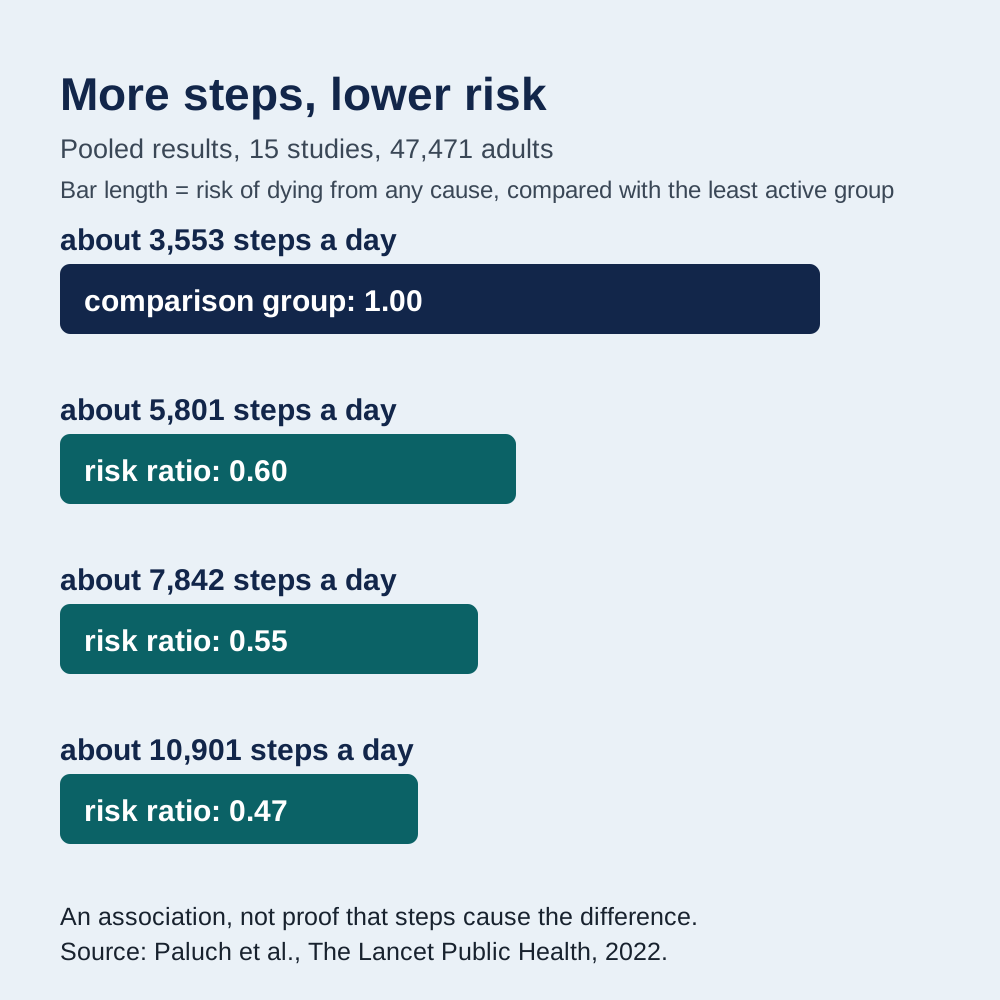
What about steps? Large studies link more daily steps with a lower risk of dying, and for adults 60 and older the gains level off somewhere around 6,000 to 8,000 steps a day. So the famous 10,000 is a round number, not a line the research drew. If you’re at 3,000 today, getting to 5,000 is a real win.
Short walks count too. In one small study, five minutes of light walking every half hour through a long sitting day kept blood sugar from climbing as much after eating. You don’t have to save all your movement for one block.
How fast, and how far
Skip the watch for a minute and use the talk test. Moderate effort means you can talk but not sing. If you can’t get a sentence out, slow down. If you could sing, you have room to go a little faster. Effort is personal: the same pace is easy for one person and hard for the next, and that’s fine.
| Effort | What it feels like | Talk test |
|---|---|---|
| Easy | A stroll. You could do this all afternoon. | You could sing |
| Moderate | Brisk. You’re warm and breathing a little harder. | You can talk, but not sing |
| Hard | You’re working and want it to be over soon. | Only a few words at a time |
For distance, think in minutes, not miles. Minutes are the same for everyone, whether you’re on flat ground, a hill or a treadmill.
Your first week: the five-and-five walk
Forget mileage. For week one the whole job is to walk out for five minutes, turn around and walk back. That’s ten minutes, and it’s a real start.
- Put the shoes by the doorWear a pair you’d be happy on your feet in all day. Leave them where you’ll trip over them.
- Pick a route you already knowA lit, familiar loop or out-and-back, on a surface you trust. Don’t invent a new route on day one.
- Walk out for five minutesGo easy for the first minute or two and let your pace settle. Use the talk test.
- Turn around and walk backSame route, same pace. If you get home with energy to spare, good. Save it for next week.
- Notice how you feelBetter or the same means you’re on track. Worse means shorten tomorrow’s walk, not skip it.
Take a comfortable 10-minute walk
About 10 minutes · Easy
Choose a familiar, safe route and walk at a pace that feels comfortable today.
Steps
- How to start
- Step outside, pick a familiar route, and set a 10-minute timer. Turn around at the halfway point.
- You will need
- Comfortable shoes and a route you already know.
- Done when
- You walked for about ten minutes, or as long as felt comfortable.
Building up without breaking down
Add time before you add speed. Starting too long or too fast is the most common way a walking plan dies, usually with a strained calf or sore feet in week one. This plan grows by a few minutes at a time.
| Week | Walks per week | Length of each walk | Notes |
|---|---|---|---|
| 1 | 4 to 5 | 10 minutes | Easy pace. Same time each day. |
| 2 | 4 to 5 | 15 minutes | Add five minutes to two of the walks. |
| 3 | 4 to 5 | 20 minutes | Try a slightly brisker pace for part of it. |
| 4 | 5 | 20 to 30 minutes | You are at or near 100 to 150 minutes a week. |
If a week feels like too much, repeat the one before it. Nothing is lost by going slowly, and nobody is checking. When you want the plan built around your own starting point, the Walking Progress Planner does the math.

Making it stick when the weather, the week or your motivation turns
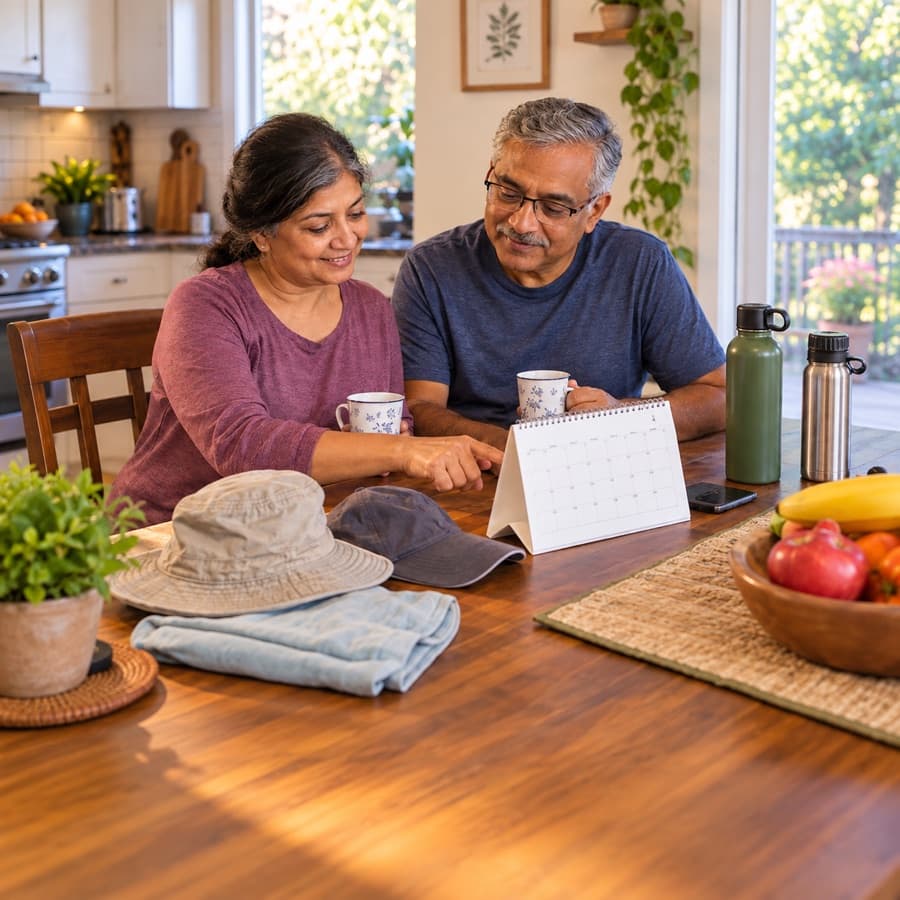
The plan is the easy part. The habit is what happens on Tuesday when it’s drizzling and the couch is warm. A few things help more than willpower does:
- Anchor it to something you already do. After breakfast, after the dishes, before the evening news. A walk with a cue is a walk that happens.
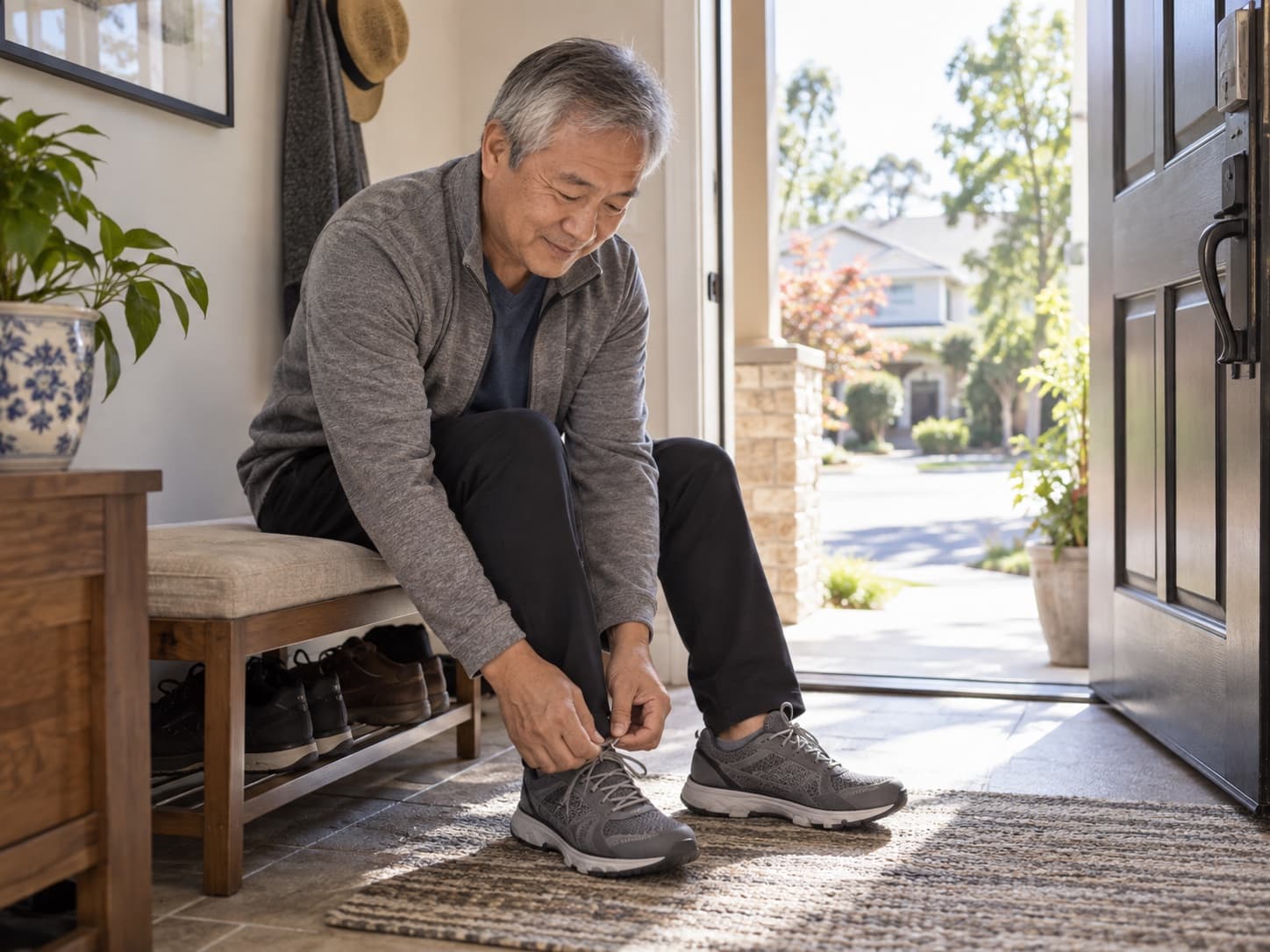
- Make the first step small. Shoes by the door, jacket on the hook. If getting started takes ten seconds, you’ll start more often.
- Walk with someone. A standing date is hard to skip, and it counts as connection too.
- Have a rainy-day plan before you need one. A hallway, a lap of the house, a shopping center. Decide the backup now, while you’re in a good mood.
- Use a step counter to watch a trend, not to chase a number. A bad day is a data point, not a verdict.
- When you miss a day, just walk tomorrow. Missing is normal. Quitting is the only way to fail.
A few things that make walking easier on your body
- Stand tall, eyes up. Looking 10 to 20 feet ahead helps you spot hazards without staring at your feet.
- Take natural steps. Overstriding strains the shins and hips. Short, quick steps are easier on the body.
- Swing your arms loosely, and don’t carry heavy loads in one hand.
- Wear supportive shoes with good grip, and replace them when the cushioning is worn.
- Add effort in small ways. A brisker stretch between two lampposts, a gentle hill, or a loop with a few stairs.
How you’ll know it’s working
The scale is a poor judge of a walking habit. These are better:
- The same loop gets easier. Walk one route every two weeks. If you finish with more breath to spare, you’re getting fitter, even if the clock hasn’t changed.
- Your weekly minutes go up. Count them. Building toward 150 over a few weeks is the goal, not reaching it by Friday.
- Your step trend rises. Look at the week, not the day.
- Ordinary life gets lighter. Stairs, groceries, keeping up with someone. That’s the point of all of this.
For a quick snapshot, the Weekly Activity Check takes two minutes.
Walking is the base, not the whole building
Walking is great for your heart and legs, but it doesn’t train strength and balance much. Pair it with strength work and balance practice and you’ve covered most of what everyday independence is made of.
Your next step
Two minutes to see how a typical week lines up with the guideline, and what one small addition would be.
Check your weekPhotos: Osman İçli on Unsplash; Crina on Unsplash.