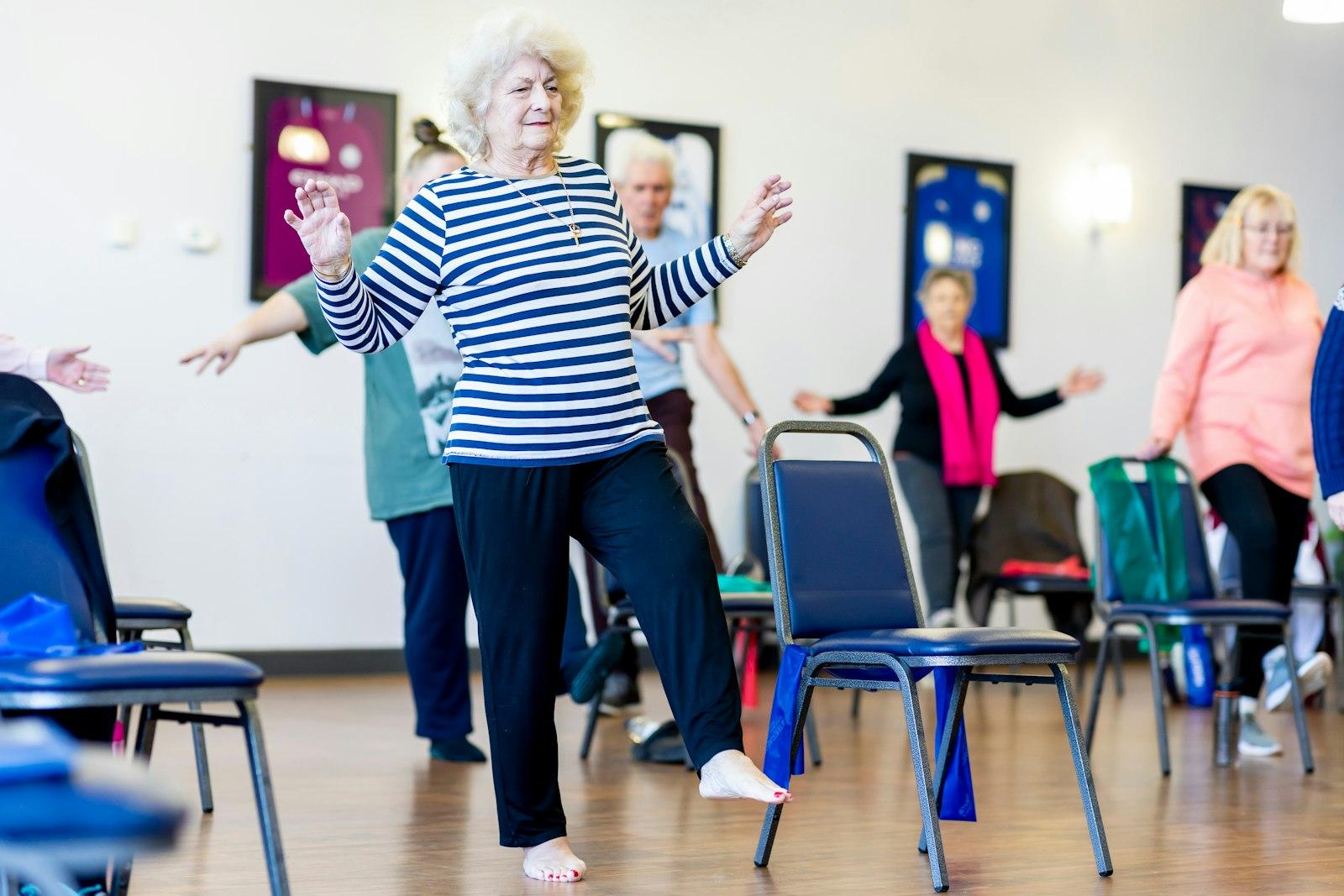
You're pulling on a sock with one foot off the floor, the other ankle starts to wobble, and your hand shoots out for the dresser. Keep that instinct. The National Institute on Aging advises about three sessions of balance exercises a week, with a sturdy chair, person, or wall nearby to hold onto. A wall or a sturdy chair is already in your home.
The American College of Sports Medicine and the American Heart Association recommend that older adults at risk of falling do balance training regularly, because better balance can help reduce the risk of falls. The evidence on exactly how to train is more modest. The trials described here enrolled people 60 and over or 65 and over, so they describe average results for groups in that age range and cannot predict what will happen for you.
What the research supports
A Cochrane review of trials in people 60 and over found that, in general, the more effective programs ran three times a week for three months and involved dynamic exercise done standing up. The review cites no direct test of frequency or length, so that is a general pattern across programs and has not been tested as a dose. A separate analysis of 12 trials of the Otago program, in adults over 65 without neurological disease, found that results were unrelated to how often people trained or for how many weeks. The same analysis found that sessions longer than 30 minutes improved static and perceived balance more than sessions of 30 minutes or less, though that is one subgroup comparison.
Otago is a program of strength and balance exercises. Its standard dose is 30 minutes, three times a week, plus outdoor walks at least twice a week, and it progresses by adding ankle cuff weights and more sets. That makes it a poor template for an equipment-free routine, and a review of eight studies found it unclear whether modified versions work as well as the original. The program is recommended for community-dwelling older adults who can exercise safely on their own and follow the instructions.
Many of the trials had flawed or poorly described methods that could bias their findings, and most did not monitor or report adverse events. Few harms were reported, but that does not show the exercises are risk-free.
Single-leg stance as an exercise and a yardstick
The Cochrane reviewers used standing on one leg as an outcome because it is necessary for safe walking in well lit and dark conditions. In three small trials of strengthening programs (120 people in all), people could stand on one leg with their eyes closed about 1.6 seconds longer afterward. That was measured right after the programs ended.
Balance is highly task-specific, so gains on one task may not carry over to another. If single-leg standing is what you practice, single-leg standing is the skill to check. None of these sources gives a hold-time target, age norms, or a tested single-leg routine.
Making it harder, carefully
Nothing in the research lays out a step-by-step progression for single-leg balance. The closest guidance comes from strength training, where the institute says gradual increases in weight, sets or repetitions, or days per week will result in stronger muscles. Applying that to balance is an analogy.

In our opinion, the sensible version is to change one thing at a time. Add a second round or a third session in the week, keep the same hand support until that feels steady, and treat repeated grabs for the support as a sign to stay at your current level.
Go slowly and mindfully. If you feel unsteady, take action to steady yourself, which at home means using your support. The sources give no cutoff for when to stop or move up. Comfortable, stable footwear or bare feet give you grip on the floor or mat. If you are unsure about a particular movement, including whether to try a harder version, ask your doctor or physical therapist.
Where to start
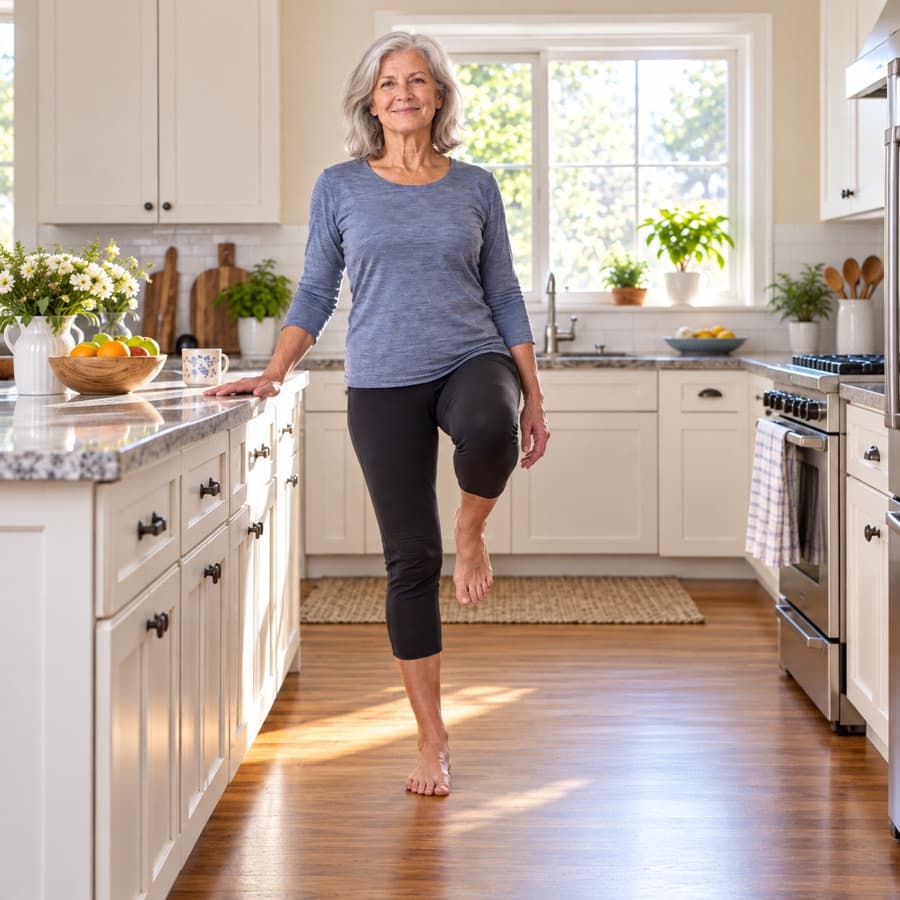
While dinner heats on three evenings this week, stand at the kitchen counter with both hands on it and lift one foot slightly off the floor for a few breaths, then switch feet. Move anything you could trip over out of the space first, so all you have to do is stand. That small start is the entry step. The institute's figure of about three sessions a week is the larger target, and it gives no session length. Once it feels steady, add a second round before changing anything else. If a week gets away from you, pick it back up at the same level at your next session.