You're on the living room rug with a grandchild and a half-finished puzzle, and you realize the next question is how you'll get up from the floor. One studied way to practice starts at the top: begin standing, then add one lower position at a time.
Why this skill matters after a fall
One paper on the topic says that even without injury, only half of the people who fall can get themselves up off the floor, and they often stay there for over an hour. That is a background statement in the paper, not a measured result, and it is not specific to people in their 50s or early 60s. Living alone, reduced mobility and cognitive impairment are linked with being unable to get up. The link does not show that they cause it or that practice overcomes it.
Practice to get up from the floor, from the top down
A pilot trial in long-term care taught residents to rise from the floor with a method called backward chaining. It starts in the most stable position, standing, then moves to kneeling, prone kneeling (on hands and knees), and finally lying on the floor. A person moves to the next step only when they can do the one before it confidently and securely.
The first step was lowering from standing with one foot forward into half-kneeling on a wedge pillow, then returning to standing. Further along, a pillow under the hip softened the floor for the half-sitting position.
What the research found
The trial had 26 long-term care residents. Sessions ran three times a week for seven weeks, 40 minutes each, with a five-minute flexibility warm-up and a five-minute cool-down of stretching and breathing exercises. Afterward, the trained group had lower fear of falling scores and higher life-space mobility scores than the comparison group. Differences in mobility, leg strength and grip strength were not significant. The abstract does not say whether residents got better at rising from the floor itself.
An earlier study, cited by the trial's authors, found that people who practiced getting up from the floor three times a week in 45-minute sessions for two weeks did it more easily and quickly than people who only did seated exercise. The authors give no details on who took part.
A physiotherapist ran the trial sessions with equipment. The sources give no sets, repetitions or rest times for practicing at home. The National Institute on Aging says staying active helps prevent falls, which is worth remembering if fear of falling has been keeping you off your feet.
Before you practice

Residents were excluded for severe pain (above 7 out of 10), physical limitations, or lower-limb joint replacement surgery within the previous six months. Those were research rules and not a screening test, but they point to who needs guidance first. Check with a clinician or physical therapist before trying this if you have significant pain, physical limitations or recent joint replacement surgery. Practice beside something sturdy you can hold, with your phone within reach.
If you fall
Decide whether you are hurt before you move, because getting up too quickly or in the wrong way could make an injury worse. If you are hurt or cannot get up on your own, ask someone for help or call 911.
When you think you can get up safely without help, roll onto your side and rest again while your body and blood pressure adjust. The National Institute on Aging's steps for reaching a chair then have you keep one leg bent so the knee stays on the floor, then rise slowly from that kneeling position and turn to sit. Those instructions come without guidance for people with knee or hip problems, so ask about that ahead of time.
The same agency advises that you keep a well-charged phone with you and arrange daily contact with a family member or friend.
Where to start
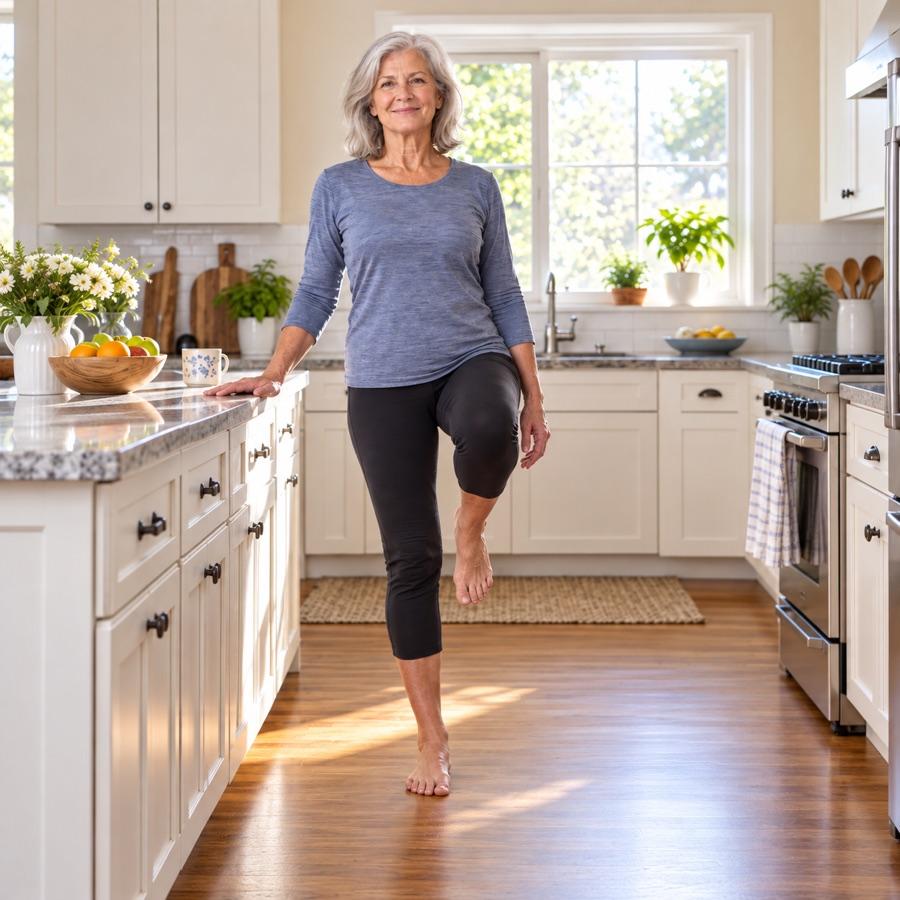
After you make lunch, stand beside a sturdy counter, step one foot forward, lower toward half-kneeling on a thick cushion, and stand back up. Leave the cushion folded by the counter so there is nothing to set up. Once that step feels secure, add hands and knees as the next position down. If a few days slip by, pick up at the step you were on.