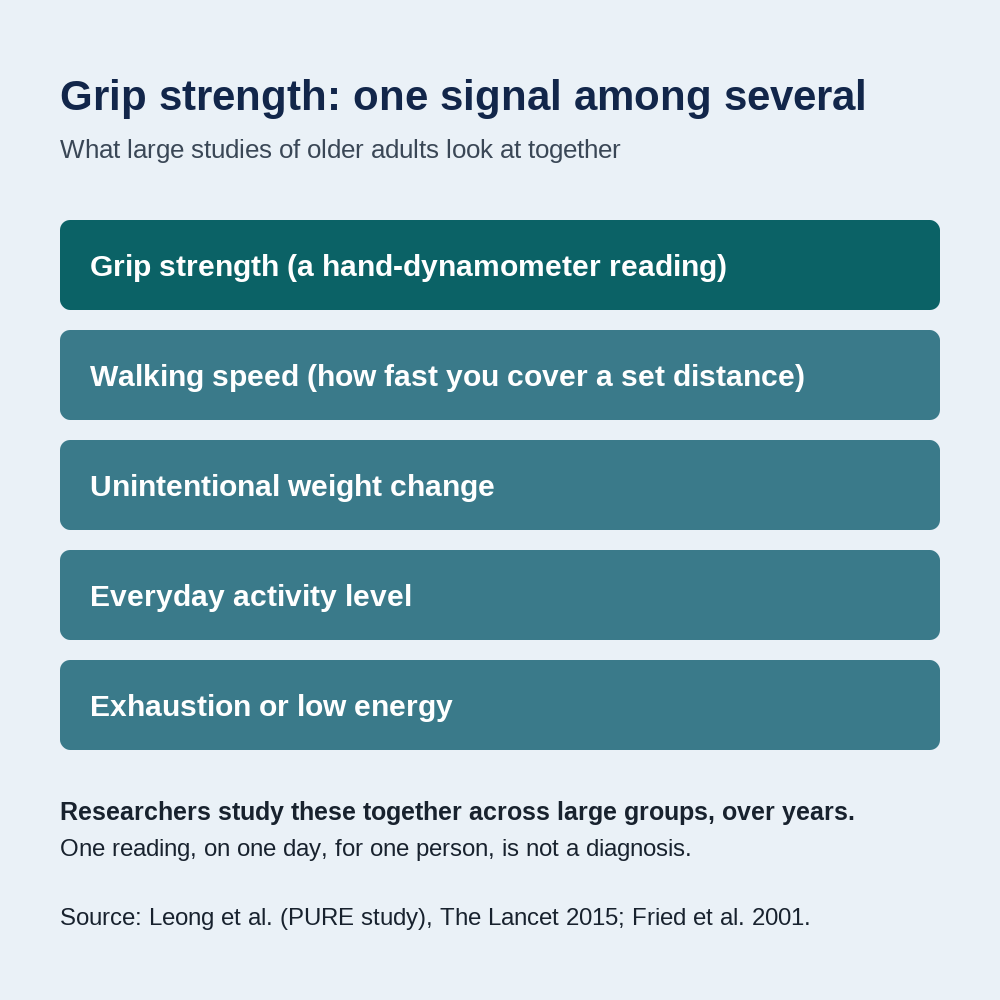
A jar of pasta sauce sits against your hip and the lid won't turn. You hand it over and wonder whether a weak squeeze means something bigger. A grip strength test, a few squeezes on a handheld gauge, is one way researchers study how people age. A low reading is one clue about risk, and most of the research is observational, so it can't tell you why your grip is what it is.
What grip strength is linked to
A review by one author recommends routine grip testing, either alone or as part of a small set of measurements, to identify older adults at risk of poor health. Several observational findings sit behind that advice.
A pooled analysis of 40 studies of death from any cause found that each 5 kilogram drop in grip strength went with a higher risk of dying. A systematic review found that all 11 studies it included showed a relationship between weaker grip and hip fractures. On falls, one study found that people who had recently fallen averaged 17.6 kilograms of grip, compared with 20.7 kilograms for people who had not. That compares group averages at one point in time, and another study found the link in men only.
Grip numbers also relate to daily tasks. One study put the grip older adults need to lift or carry an object of 11 kilograms at 18.5 kilograms for women and 28.5 for men.
These findings are all associations. The sources do not show that raising your grip lowers your risk of dying, falling or breaking a hip.
Why one cutoff won't settle it
Across six studies that defined slow walking as under 0.8 meters per second, grip thresholds ranged from 23.2 to 39.0 kilograms for men and 15.9 to 22.0 for women. Another study found that 37.0 kilograms for men and 21.0 for women identified older adults who had difficulty walking 0.5 kilometer or climbing stairs. The thresholds shift with the device, the method and the people studied, so no single number works as a pass-fail line.
Norwegian researchers published reference values for people 40 and older in Tromsø, Norway, measured with one device model. In that group, grip was higher in men than in women and fell with age. People with a self-reported history of non-communicable disease (long-term illness) had lower grip than those without. Those differences between groups don't show which came first, and values from one city and one device may not transfer elsewhere.
How to test grip the way researchers do

The Tromsø team used a digital hand dynamometer (a squeeze gauge) and trained staff. Participants sat in a chair with the arm resting on the armrest, the elbow bent at 90 degrees, the hand free of the armrest and the thumb up. Each person squeezed three times with each hand, alternating right and left, for six squeezes in all, and the highest of the six counted. One paper notes that hand dominance does not appear to matter for grip strength.
Home and consumer gauges may read differently from that research model, and the sources describe no way to check grip at home without a dynamometer. Compare yourself only with your own earlier readings on the same device and in the same position.
What raises grip
The trial evidence here is for resistance training. A meta-analysis of 14 randomized trials pooled 561 adults aged 65.8 to 82.8 who had sarcopenia, an age-related loss of muscle, and were otherwise healthy. It concluded that resistance training improves muscle strength and performance in this group. How much handgrip improved varied a lot from trial to trial. Gains also differed with age, sex, weight and the program's length, frequency, type and intensity.
One study found that a six-week squat routine improved grip and knee strength in older women with sarcopenia. In our view, that hints that leg work may carry over to the hands, though one study can't settle it.
These trials don't cover everyone over 50 or people with other chronic conditions. The sources give no sets, reps, loads or weekly schedule, so this guide gives none. A qualified trainer can set those for you.
What grip can't tell you
The review that recommends grip testing also advises caution in using grip strength as an indicator of overall strength. In one study, the link between low grip and heart events disappeared after researchers accounted for baseline heart risk, so the evidence on heart disease is mixed. A study of older adults admitted to surgical wards concluded that grip was not suitable for screening for malnutrition, though other studies in the review found associations.
Where to start
While the coffee brews tomorrow, look for a clinic, gym, physical therapy office or senior center near you that has a hand dynamometer. Copy the test position onto an index card and keep it by your phone: seated, elbow at 90 degrees, thumb up, three squeezes per hand, best one counts. The card means you won't have to remember the steps when you get there. Once you have a first reading, write down the number, the date and the device, and ask to use the same one next time. If you want to work on strength, the next step is asking a trainer to show you a squat you can do comfortably.